
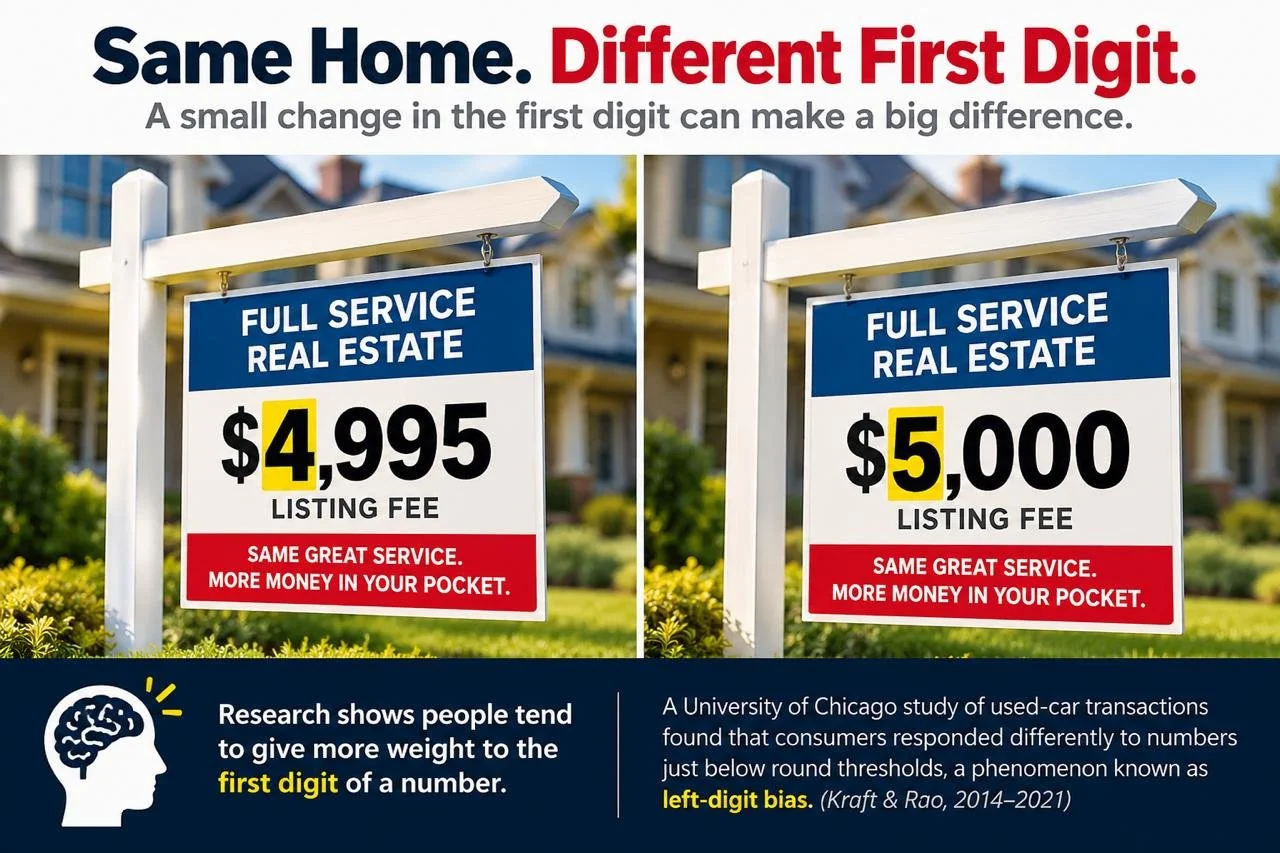
The psychology behind a $4,995 listing fee—and why the numbers you advertise might be more important than you think.
Here's a question: Why does almost every real estate agent advertise what they do, but so few advertise what they charge?
Think about it.
Open a real estate magazine. Scroll through Facebook. Drive past a few billboards. Look at the typical real estate agent's website.
You'll see the same tired messages everywhere.
"Experience You Can Trust."
"Your Local Real Estate Expert."
"Committed to Exceptional Service."
"Thinking of Selling? Call Me!"
Sound familiar?
There's nothing necessarily wrong with those statements. The problem is that everybody says the same thing.
And when everybody sounds the same, nobody stands out.
Meanwhile, the homeowner thinking about selling has a very important question that almost none of those advertisements answer.
"What's this going to cost me?"
It's one of the biggest questions in the entire transaction. Yet much of our industry treats the answer like a closely guarded secret.
Why?
The $4,995 Advertisement That Changes the Conversation
Now imagine two real estate advertisements appearing side by side.
The first says:
"Professional Real Estate Services. Call Today for a Free Consultation."
The second says:
"Full-Service Real Estate. $4,995 Listing Fee."
Which one tells the homeowner something they didn't already know?
Which one gives them a reason to stop scrolling, take a second look, or pick up the phone?
And which company has immediately established a point of difference?
The second advertisement hasn't just offered a service.
It's answered a question.
And that's powerful marketing.
But there's something else going on here. Something many agents and brokers have probably never thought much about.
Why $4,995?
Why not $5,000?
After all, we're talking about a difference of five dollars.
It turns out there may be a very good reason.
The University of Chicago, Used Cars, and the Psychology of $4,995
A fascinating University of Chicago Booth School of Business study, highlighted in October 2026, examined how consumers respond to numbers and pricing.
Researchers Andreas Kraft and Raghunath Rao analyzed vehicle transactions in Texas between 2014 and 2021.
They discovered something interesting about how consumers perceive numbers.
Consider two otherwise comparable used cars.
One has 49,800 miles.
The other has 50,200 miles.
Just 400 miles separate them. Yet consumers can perceive those numbers very differently.
Why?
Because the first car has a four at the beginning of its mileage, while the second has a five.
Researchers call this left-digit bias.
Our brains tend to give disproportionate attention to the first digit of a number, even when the actual numerical difference is relatively small.
The study found that this psychological tendency influenced used-car valuations and dealership transactions.
Now think about that in terms of advertising a real estate listing fee.
$5,000.
$4,995.
Same general price range. Just five dollars apart.
But one begins with a five. The other begins with a four.
And that subtle difference can affect how a price is initially perceived.
The Chicago study wasn't about real estate commissions, and it doesn't prove that a $4,995 advertisement will generate more listings than a $5,000 advertisement.
But it illustrates an important principle that sophisticated marketers understand.
The way you present a price can matter almost as much as the price itself.
And that's precisely why the numbers we choose deserve serious thought.
We Didn't Just Pull a Number Out of Thin Air
Here's what I want agents and brokers considering an Assist2Sell franchise to understand.
There is a reason behind how we approach our pricing and advertising.
We think about the numbers.
We think about how consumers perceive them.
We think about how an offer appears in an advertisement, how it compares to competing offers, and how it performs in the marketplace.
And we test our marketing.
A $4,995 fee isn't just a number to put on a flyer. It's part of a much larger marketing strategy.
Research into consumer behavior helps inform that strategy. Actual advertising results help us evaluate it.
Because there's a big difference between guessing what might work and making informed marketing decisions.
And the same thinking should extend beyond pricing.
The headlines we use. The words in our advertisements. The offers we promote. The way we communicate the value of our services.
Details matter.
Here's the bigger point.
If we're willing to put this much thought into the psychology of a five-dollar difference, imagine the importance we place on the rest of the marketing strategy.
That's the kind of thinking that should go into building a real estate business.
Not just choosing a brokerage name, putting up a website, and hoping someone calls.
Transparency Isn't Just Good for Consumers. It's Good for Business.
Some agents are uncomfortable advertising their fees.
They worry that it makes real estate a commodity. That they'll attract price shoppers. That they'll have to explain their pricing before they've had the opportunity to demonstrate their value.
I would argue the opposite.
When you clearly advertise your fee, you're telling prospective sellers something important about how you do business.
You're confident enough in your pricing to put it out there for everyone to see.
You're willing to answer one of their biggest questions before they even ask.
And you're giving them something meaningful to compare.
That's not a weakness.
That's credibility.
Today's consumers are accustomed to comparing prices, reading reviews, researching options, and making informed decisions before contacting a salesperson.
Why should real estate be any different?
A seller shouldn't have to sit through a 45-minute listing presentation just to find out what your services might cost.
And here's another benefit: When someone calls because they've seen your advertised fee, you've already started the conversation on your terms.
They know there's something different about your business.
Now you get to demonstrate just how much value you deliver.
Of course, transparency means being clear about what the listing fee includes and what costs may be separate, including any buyer-broker compensation. The purpose of the advertised number isn't to mislead consumers. It's to make a genuine offer easier to understand.
The Real Advantage Isn't Just a Lower Fee. It's a Better Story.
Here's where I believe many real estate professionals miss the bigger opportunity.
They're so focused on competing with other agents that they forget about the importance of being different.
They join another brokerage, adopt another logo, create another website, and advertise the same services with the same tired messages.
Then they wonder why generating listings is so difficult.
You can't build a compelling marketing advantage by looking, sounding, and behaving exactly like your competition.
You need a reason for homeowners to notice you.
A reason for them to remember you.
A reason for them to consider calling you instead of the other 20 agents competing for their business.
That's where the Assist2Sell business model becomes interesting.
For decades, Assist2Sell has built its consumer message around a simple proposition:
Full Service with $avings.
Not a stripped-down service. Not merely putting a property in the MLS and hoping for the best.
Professional representation, property marketing, negotiations, transaction coordination, and the services sellers expect from a full-service real estate company.
But with a pricing model designed to offer consumers an opportunity to save money.
That's a much more compelling advertising story than simply saying, "I'm a great real estate agent."
And when the advertising includes a clear, attractive fee, the message becomes even more powerful.
You're not just promising value.
You're giving the homeowner a reason to investigate it.
Stop Competing for Attention. Give People a Reason to Pay Attention.
Consider this: A company advertising a $4,995 listing fee isn't merely competing against another company charging $5,000.
It's competing against an entire marketplace of agents who often don't advertise any price at all.
Sure, there's psychology behind the choice of $4,995 instead of $5,000.
But there's an even bigger marketing advantage.
It's the difference between advertising an actual offer and advertising another vague promise.
And that difference can be enormous.
An attractive price gets attention.
A clear offer creates interest.
Transparency builds credibility.
And delivering professional service and genuine value is what ultimately earns the client's business.
That's how the pieces fit together.
The advertised fee is an important part of the strategy. But it's not the entire strategy.
What If Your Business Model Was Your Best Marketing Tool?
If you're an agent or broker considering a change, ask yourself something.
What if your brokerage gave you more than a recognizable name, a commission split, and a collection of marketing templates?
What if it gave you a business model that was inherently marketable?
A message that immediately separated you from traditional competitors.
A value proposition homeowners could understand in seconds.
And an approach to pricing and marketing built around consumer behavior, thoughtful research, and testing?
That's the opportunity behind the Assist2Sell model.
We're not simply interested in being cheaper.
We're interested in being smarter about how we compete.
Because the real estate industry doesn't need another brokerage telling consumers how wonderful its agents are.
It needs more real estate businesses giving consumers a compelling reason to choose them.
And for agents and brokers building those businesses, that requires something more than another commission plan.
It requires a strategy.
A differentiated business model.
A message that resonates.
And the discipline to pay attention to the details that make marketing work.
Even the last five dollars.
Because sometimes the difference between an ordinary real estate business and an extraordinary one starts with thinking differently about the little things.
Interested in building a real estate business with a compelling consumer value proposition and a different approach to marketing? Explore franchise opportunities with Assist2Sell at BuyAssist2Sell.com.
The $4,995 listing fee is an illustration, not a nationwide offer. Fees, services, and programs vary by office and market. Real estate compensation is negotiable, and actual savings depend on the services and proposals compared.