
In a slower, more selective housing market, sellers do not suddenly stop wanting professional help. They start asking better questions.
Why is my home sitting longer? What should I price differently? What exactly am I paying for? How much will I net if I accept a lower offer, contribute to buyer costs, or adjust my asking price? And increasingly: is there a smarter way to get a full-service real estate expert without simply defaulting to the most familiar fee structure?
That shift is easy to miss if you only watch headline home prices. But the spring 2026 data is telling a more interesting story. Realtor.com’s April 2026 housing report found that active listings were up 4.6% year over year, the national median list price was down 1.4% from a year earlier, and median days on market rose by two days.
For real estate agents and brokers, the takeaway is not that the market is weak. It is that the customer is changing.
When inventory rises and homes take longer to sell, sellers become more sensitive to every line item that affects their proceeds. In a market where the national median list price is still $425,000, according to Realtor.com’s April data, even small percentage differences in selling costs can feel significant to a homeowner who is also navigating mortgage-rate pressure, moving expenses, repair negotiations, and uncertain buyer demand.
At the same time, the industry is still adjusting to a more transparent commission environment. The National Association of REALTORS® has continued to explain the post-settlement practice changes that took effect in 2024, including written buyer agreements before touring homes and the removal of offers of compensation from MLS fields. Those changes did not eliminate the need for skilled agent. If anything, they made the value conversation more explicit.
For smart forward thinking agents, this begs the question: is your business model built for the way consumers now evaluate real estate service?
Value and savings is no longer a side conversation
The old assumption was that most sellers would focus first on choosing an agent, then deal with the fee conversation as part of the listing presentation. Today, many consumers are doing the math earlier. They are using AI for research. They are comparing net proceeds. They are asking what is included. They are hearing more about negotiable commissions, flat-fee options, limited-service models, and alternative brokerages.
Some of those options may fit a seller’s needs; others may leave gaps. But the broader consumer behavior is clear: value and savings is no longer a side conversation.
That is where business model matters.
An independent agent or broker can certainly reposition around value, but doing so from scratch is difficult. The agent must create the messaging, explain the model, build operational systems, develop listing presentation materials, support sellers through objections, and find a way to stand out without sounding like everyone else. In a noisy market where most agents do and promote the same things, differentiation is not just a tagline. It has to show up in how the business is structured.
Why franchising belongs in the conversation
Franchising is relevant here because it offers a middle path between independence and starting alone. The franchise sector has remained a significant part of the U.S. small-business landscape, and the International Franchise Association’s 2025 Economic Outlook projected continued franchise growth, including more than 20,000 new franchise units and roughly 210,000 additional jobs in 2025.
The appeal is not that franchising removes risk. It does not. The appeal is that it gives an owner a framework: a recognizable model, established systems, training, shared positioning, and a way to enter business ownership without inventing every piece of the company at once.
For real estate professionals, that distinction matters. Many experienced agents already know how to win clients, negotiate, manage transactions, and understand local market dynamics. What they often lack is not ambition; it is a platform and brand that makes them stand out.
Where Assist2Sell fits
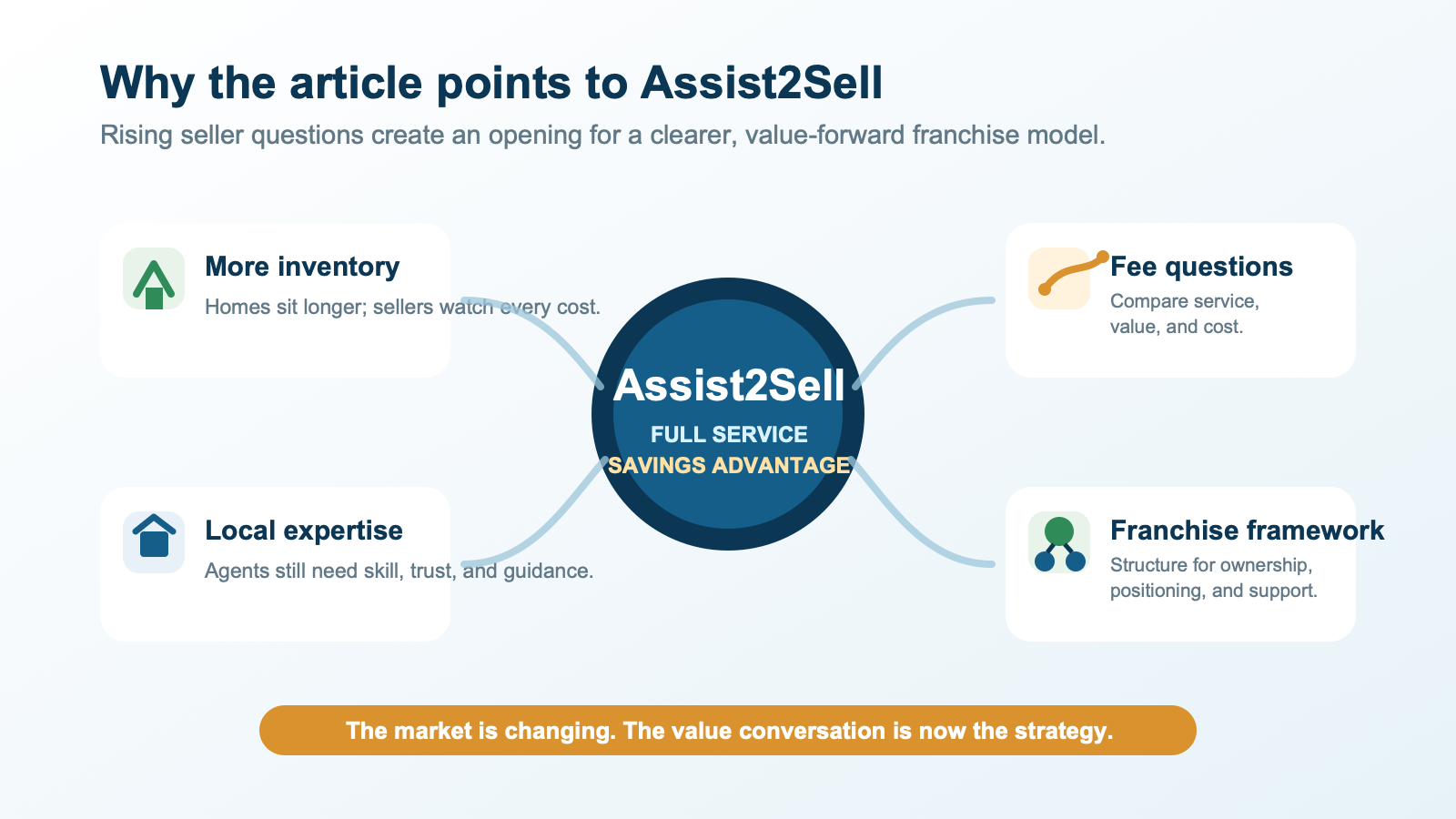
Assist2Sell fits into this moment because it was purpose built from the ground up around a value-driven idea: full-service real estate service with a savings advantage. This is especially relevant in a market where sellers are more likely to compare their net, question fees, and look for a model that does not force them to choose between professional service and cost-consciousness.
The opportunity is not based on telling consumers that every seller will save the same amount or that a lower fee automatically solves every problem. Actual savings vary, fees and services may vary by local office, and each seller’s situation is different. The stronger point is more practical: Assist2Sell gives agents and brokers a clear way to enter the value conversation with a mission built around seller savings, service clarity, and local real estate expertise.
That can be powerful for an agent who wants to own a business rather than remain dependent on someone else’s brand, office structure, or lead flow strategy. Instead of competing only on personality, sphere of influence, or generic “full service” promises, an Assist2Sell agent and broker can lead with a consumer problem that is becoming more visible: sellers want capable representation and a more thoughtful fee conversation.
This does not mean every market will respond the same way. Real estate remains local. Inventory conditions, price sensitivity, buyer demand, and competitive alternatives vary widely. But the national signals point in the same direction: consumers are paying closer attention, and agents who can explain value clearly may have an advantage in earning trust.
The next version of the market
That is why the current market may be more than a temporary cycle. It may be a forcing function. Higher borrowing costs have made buyers more cautious. More inventory has given them more leverage. Sellers are adjusting expectations. Compensation conversations are more transparent. And agents are being asked to justify not only what they do, but how their business model helps the client make a better decision.
For licensed agents with entrepreneurial instincts, the question is no longer simply, “Should I start my own brokerage someday?”
A better question may be: “What kind of real estate company would make sense for the next version of the market?”
One answer is a company built for consumers who want professional guidance, clear value, and a reason to believe their agent is thinking about their net proceeds as carefully as they are. That is the space Assist2Sell is designed to occupy.
The agents who study and adapt to this shift now will be better prepared for what comes next. Markets change. Consumer expectations evolve. But the business owners who can combine local expertise with a model that speaks directly to seller value may be the ones who turn today’s uncertainty into a more durable opportunity.